Sep 29, 2026Regulations & Compliance
EN 14604 Explained: What Importers Must Verify Before Sourcing
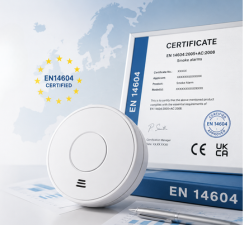
EN 14604 is the European standard for residential smoke alarms. Here is what it actually covers, what a compliant test report should contain, and the five things importers must verify before...
EN 14604 Explained: What Importers Must Verify Before Sourcing
If you import residential smoke alarms into the European Union or the United Kingdom, EN 14604 is the standard you will be asked about first. It is the European product standard for smoke alarm devices used in dwellings, and it is the document buyers, insurers and retailers use to judge whether an alarm is suitable for the residential market at all.
This guide answers the questions importers actually ask: what EN 14604 tests, what a compliant test report contains, and the five points to verify before you place a purchase order.
What EN 14604 actually covers
EN 14604 —*Smoke alarm devices* — specifies requirements, test methods, performance criteria and marking for smoke alarms intended for residential use. It applies to both sensing technologies commonly sold in Europe:
• Photoelectric (optical) alarms, which detect larger smoke particles from smouldering fires.
• Ionization alarms, which detect smaller particles from fast-flaming fires.
The standard is not a certification scheme by itself. It defines *how* an alarm must behave; a test report from an accredited laboratory demonstrates that a specific model has been tested to those requirements.
The performance points that matter commercially
Requirement area | What it means for the product you sell |
Alarm sound output | A minimum sound pressure level at a defined distance, so the alarm can wake occupants |
Response to test fires | The alarm must respond within prescribed time limits to defined test smoke |
Nuisance alarm resistance | Limits on false alarms, and a hush/silence function |
Battery and power | Requirements for battery life, low-battery warning and, where applicable, sealed power sources |
Marking and instructions | Correct labelling plus installation and maintenance information |
Importers' first mistake: treating "EN 14604" as a brand or a badge. It is a test standard. What proves your product is compliant is the test report that names the model and the standard version.
What a valid EN 14604 test report should contain
Before you accept a certificate image from a supplier, check that the underlying report includes:
1. The exact standard and year, written as `EN 14604:2005` with any amendments (for example `EN 14604:2005/AC:2008`). A report that says only "EN 14604" without a version is incomplete.
2. The model designation on the report, matching the model on the carton and the nameplate. Reports cannot be transferred to a different model.
3. The laboratory's identity and accreditation, with a report number that can be checked.
4. The test results table, not just a pass/fail stamp.
5. The manufacturer's name and the production site covered by the test.
V-COME's residential smoke alarms are tested against EN 14604:2005/AC:2008. The applicable report and its number are issued with each order on request.
The five things to verify before you order
• Standard version and scope. Confirm the report cites the current EN 14604, and that the scope covers smoke alarms for dwellings — not a different product category.
• Model-to-report match. Cross-check the report model against the packaging you will actually receive. A report for a discontinued model is not evidence for a new one.
• Who tested it. Look for an accredited third-party laboratory, not an in-house sheet with no lab identity.
• The document set. Ask for the test report and the manufacturer's Declaration of Conformity. They are different documents and both may be requested at customs or by a retailer.
• Ongoing production control. A type test on one sample is not the same as production consistency. Ask how the factory controls production quality (see our factory audit checklist).
Where EN 14604 sits in the wider compliance picture
EN 14604 is the smoke-alarm product standard. It is not the same thing as CE marking. CE marking comes from the applicable EU directives — typically EMC, RoHS, and RED for wireless models — and a Declaration of Conformity references those directives. A smoke alarm can hold an EN 14604 test report and still need separate CE/RoHS/RED documentation to be placed on the EU market.
Similarly, the United Kingdom market recognises the UKCA marking route. Products may carry CE or UKCA depending on the market and the current UK rules.
FAQ
Is EN 14604 the same as CE?
No. EN 14604 is a product test standard for smoke alarms. CE marking is the EU's conformity marking, based on the relevant directives (EMC, RoHS, RED for radio models). Both are usually needed, and they are documented separately.
Does EN 14604 cover carbon monoxide alarms?
No. CO alarms are covered by EN 50291. A combination smoke and CO alarm must satisfy both standards.
Does EN 14604 cover heat alarms?
No. Heat alarms are covered by the BS 5446-2 / EN 54 family depending on the application. Do not accept a smoke-alarm test report as evidence for a heat alarm.
How long is an EN 14604 test report valid?
Test reports do not carry a fixed expiry, but the standard version and the product must stay matched. If the standard is revised or the product changes, the report must be reissued. Ask for the version date on every order.
About V-COME — Focused. Professional. Reliable.
V-COME Safety Technology Co., Ltd is a Dongguan-based manufacturer of smoke alarms, carbon monoxide alarms, heat alarms and combination alarms, plus RF and Wi-Fi interconnected solutions for distributors, importers and private-label brands. Certified to EN 14604:2005/AC:2008, BS 5446-2:2003, EN 50291-1:2018, UKCA, CE, RoHS, REACH and ISO 9001:2015; UL 217 / UL 2034 in progress.
Contact: Jessy Chen — jessy@vcome-safety.com