Oct 1, 2026Regulations & Compliance
CE Marking for Smoke and CO Alarms: Which EU Directives Actually Apply
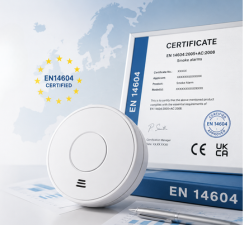
CE marking is not a single certificate and EN 14604 is not a CE directive. This guide maps the EU directives that actually apply to smoke, heat and CO alarms — EMC, RoHS, RED, LVD and WEEE — and...
CE Marking for Smoke and CO Alarms: Which EU Directives Actually Apply
Ask ten suppliers what "CE certified" means for a smoke alarm and you will get ten different answers. That is because CE marking is not a certificate, and EN 14604 is not a CE directive. CE is a manufacturer's declaration that a product meets the EU legislation that applies to it — and for a smoke, heat or CO alarm, which legislation applies depends on how the product is powered and whether it communicates wirelessly.
This guide maps the directives that actually apply, so you can read a supplier's Declaration of Conformity (DoC) with confidence.
The key distinction: product standards vs directives
• Product standards (EN 14604, EN 50291, BS 5446-2) define how an alarm must perform. They are test standards.
• EU directives define legal obligations and are what CE marking is declared against.
A test report to EN 14604 proves performance. It does not, by itself, put a CE mark on the product. The CE mark needs a DoC referencing the applicable directives.
Which directives apply?
Directive | Applies when— | Notes for alarms |
EMC Directive 2014/30/EU | The device has electronics | Applies to virtually all modern alarms, mains or battery |
RoHS Directive 2011/65/EU | Any electrical/electronic product | Restricts hazardous substances; DoC should reference it |
Radio Equipment Directive (RED) 2014/53/EU | The alarm transmits or receives by radio — RF interlinked, Wi-Fi, Zigbee | Replaces the old R&TTE directive; drives radio testing |
Low Voltage Directive (LVD) 2014/35/EU | Mains-powered equipment within its voltage scope | Applies to mains-powered/230 V models; battery-only units are usually outside LVD |
WEEE Directive 2012/19/EU | Electrical/electronic equipment | Concerns take-back and marking; relevant to the seller's obligations |
A battery-only, non-wireless smoke alarm may therefore need EMC + RoHS (and WEEE considerations), while a Wi-Fi or RF model adds RED. A mains-powered interlinked alarm adds LVD. There is no single fixed list — it depends on the configuration.
Radio models: the RED point importers miss
If your alarm uses RF interconnect, Wi-Fi or Zigbee, it is radio equipment and falls under RED 2014/53/EU. That means radio performance, spectrum use and possibly additional safety requirements apply, and the technical documentation should include the relevant radio test evidence. Suppliers who only mention "CE + EN 14604" for a wireless product have not shown you the radio compliance.
What the Declaration of Conformity must contain
A proper EU DoC is a formal document that should include:
1. The manufacturer's name and address (or authorised representative in the EU).
2. The product identification — model number(s) — matching the product.
3. A list of the directives applied, with their numbers and dates.
4. The harmonised standards used (for example EN 14604, EN 50291, EN 55032, EN 55035).
5. The place and date of issue, and the signatory's name and function.
6. Where applicable, reference to the notified body involved.
If a document titled "CE Certificate" lists no directives, it is not a valid DoC — it is marketing material.
The five checks for an importer
• Directive list matches the product. A battery Wi-Fi alarm should reference EMC, RoHS and RED.
• Standards cited are current. Look for the year (e.g. `EN 14604:2005/AC:2008`).
• Model numbers match everything else you have (report, packaging, nameplate).
• Wireless claims have radio evidence — a RED test report or equivalent.
• You, as importer, understand your own duty. Importers placing goods on the EU market carry responsibility for the goods being compliant; keep the DoC and technical file accessible.
FAQ
Does EN 14604 give me CE marking?
No. EN 14604 is a product standard. CE marking comes from the applicable directives, documented in the DoC.
Is a wireless smoke alarm "CE + EN 14604" enough?
Not as a description. A wireless alarm also involves the Radio Equipment Directive. Ask for the radio test evidence.
Do I keep the DoC, or does the factory?
Both. The manufacturer issues it; the importer must be able to produce it for market surveillance authorities.
Can I CE-mark a product myself if the factory is outside the EU?
Generally the manufacturer (or an authorised representative) issues the DoC. As the importer, you must ensure it exists and is correct. For radio products, check whether a notified body is required for any part of the assessment.
About V-COME — Focused. Professional. Reliable.
V-COME Safety Technology Co., Ltd supplies smoke, CO, heat and combination alarms plus RF/Wi-Fi interconnected models, with CE/UKCA/RoHS/REACH documentation for distributors, importers and private-label brands. Certified to EN 14604:2005/AC:2008, BS 5446-2:2003, EN 50291-1:2018 and ISO 9001:2015; UL 217 / UL 2034 in progress.
Contact: Jessy Chen — jessy@vcome-safety.com