Oct 9, 2026Buying Guides
Combination Smoke and CO Alarms: When 2-in-1 Beats Two Separate Units
A combination smoke and CO alarm covers two hazards in one ceiling position. This guide explains when that is the right choice, when separate units are better, and what to confirm before stocking...
Combination Smoke and CO Alarms: When 2-in-1 Beats Two Separate Units
A combination smoke and CO alarm puts two life-safety sensors in a single housing: an optical smoke sensor to catch smouldering and flaming fires, and an electrochemical CO sensor to catch carbon monoxide from fuel-burning appliances. For the right installation, it is the most efficient product in the range. For the wrong one, it is an expensive mismatch.
This guide explains where combination units win, where they don't, and what importers should verify before stocking them.
What a combination alarm is — and isn't
It is a single unit that detects two hazards in one location. It is not a whole-home solution. Every place that needs coverage still needs coverage; the combination unit simply covers two hazards at one ceiling point.
A separate point often misunderstood: a combination alarm must satisfy both underlying standards —EN 14604 for the smoke function and EN 50291-1 for the CO function. Ask for evidence covering both.
When 2-in-1 is the better choice
Situation | Why combination wins |
Small flats / studio apartments | Limited ceiling positions; one unit covers two risks |
Rooms with a fuel-burning appliance near a living area | Smoke and CO risk in the same space |
Regulated retrofit where reducing fitting time matters | One install instead of two |
Premium / design-conscious residential | Fewer, cleaner ceiling devices |
Landlord compliance packages | Simpler specification and fewer SKUs on site |
When separate units are better
• Kitchens. You need a heat alarm, not a smoke sensor. A combination smoke + CO unit in a kitchen will still false-alarm on cooking smoke. Pair a kitchen heat alarm with a CO alarm where the boiler is nearby.
• Maximum sensor life alignment. Smoke and CO sensors have different service lives and end-of-life signals. Separate units let you replace each on its own schedule.
• Cost-sensitive bulk contracts where two basic units are cheaper than one combination.
• Distributed coverage planning where you want each hazard covered independently across rooms.
What to check before stocking combination alarms
1. Both certificates. Reports for the smoke function (EN 14604) and the CO function (EN 50291-1), matching the same model.
2. Alarm differentiation. Can the user tell a fire alarm from a CO alarm? Distinct sound patterns, voice alerts or indicators are essential.
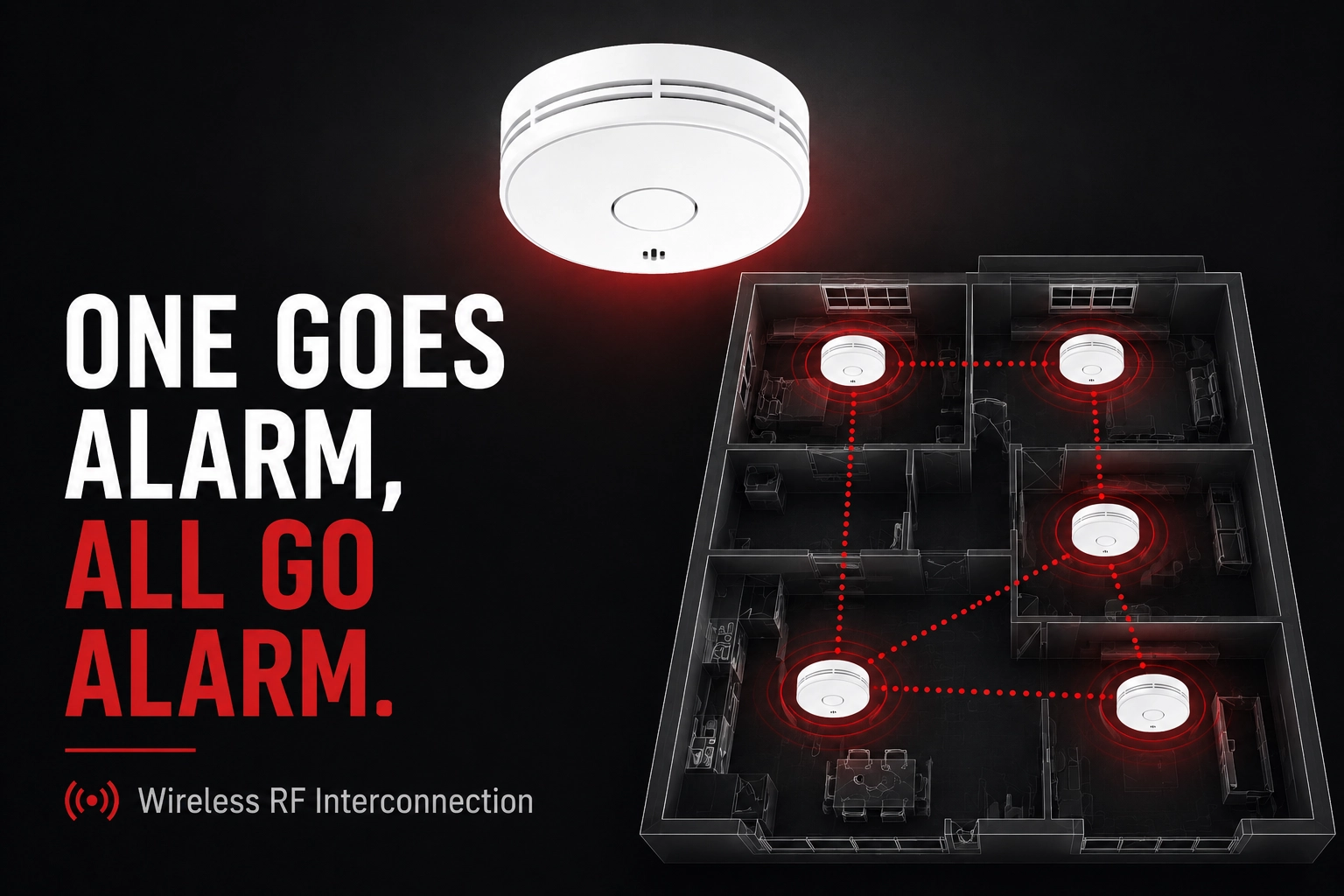
3. Interlinking. If it is part of a whole-home system, confirm it interlinks with your heat, smoke and CO devices.
4. Sensor type and life. Confirm the CO sensor technology and the rated life, plus the end-of-life signal.
5. Indicator clarity. CO display or status indicators, low-battery signalling, and a test function that tests both sensors.
The range logic
Most successful residential ranges carry both: separate units as the volume workhorses, and combination units as the premium SKU for smaller dwellings and specification-driven projects. V-COME's combination range includes smoke + CO and smoke + heat models, in standalone, wireless interlinked and Wi-Fi variants with voice alert options.
FAQ
Does a combination alarm replace the need for a dedicated CO alarm?
No. It detects CO in its own location. A boiler in another room still needs its own CO coverage.
Can I put a combination smoke + CO alarm in a kitchen?
It is not recommended, because the smoke sensor will respond to cooking. Use a heat alarm in the kitchen and a CO alarm where the fuel-burning appliance is.
Are combination alarms more expensive than two separate units?
Often yes, per unit — but they can be more economical in total once you factor installation time, ceiling positions and specification simplicity.
Do combination alarms need two test reports?
Yes. The smoke and CO functions each have their own standard, so you should expect evidence for both.
Sources
• EN 14604:2005 + A1:2022, *Smoke alarm devices* — CEN.
• EN 50291-1:2018, *Electrical apparatus for the detection of carbon monoxide in domestic premises* — CEN.
• Regulation (EU) No 305/2011 (Construction Products Regulation) — EUR-Lex.
• Scottish Government guidance on the interlinked alarm standard (heat alarm in the kitchen).
About V-COME — Focused. Professional. Reliable.
V-COME Safety Technology Co., Ltd manufactures combination alarms (smoke + CO, smoke + heat) in standalone, RF-interlinked and Wi-Fi variants, with voice-alert models, alongside its dedicated smoke, CO and heat ranges. Certified to EN 14604:2005/AC:2008, BS 5446-2:2003, EN 50291-1:2018, UKCA, CE, RoHS, REACH and ISO 9001:2015.
Contact: Jessy Chen — jessy@vcome-safety.com